We’ve all done it—fingers flying over the screen, heart spilling into a text: “I love you more than I ever said,” or “I’m sorry I ghosted,” or just “Thanks for seeing me when no one else did.” Then the freeze hits. The little blue arrow taunts you. You reread, cringe, delete line by line until the box is empty again. That unsent message doesn’t disappear, though; it nests in your chest like a bird that never learned to fly.
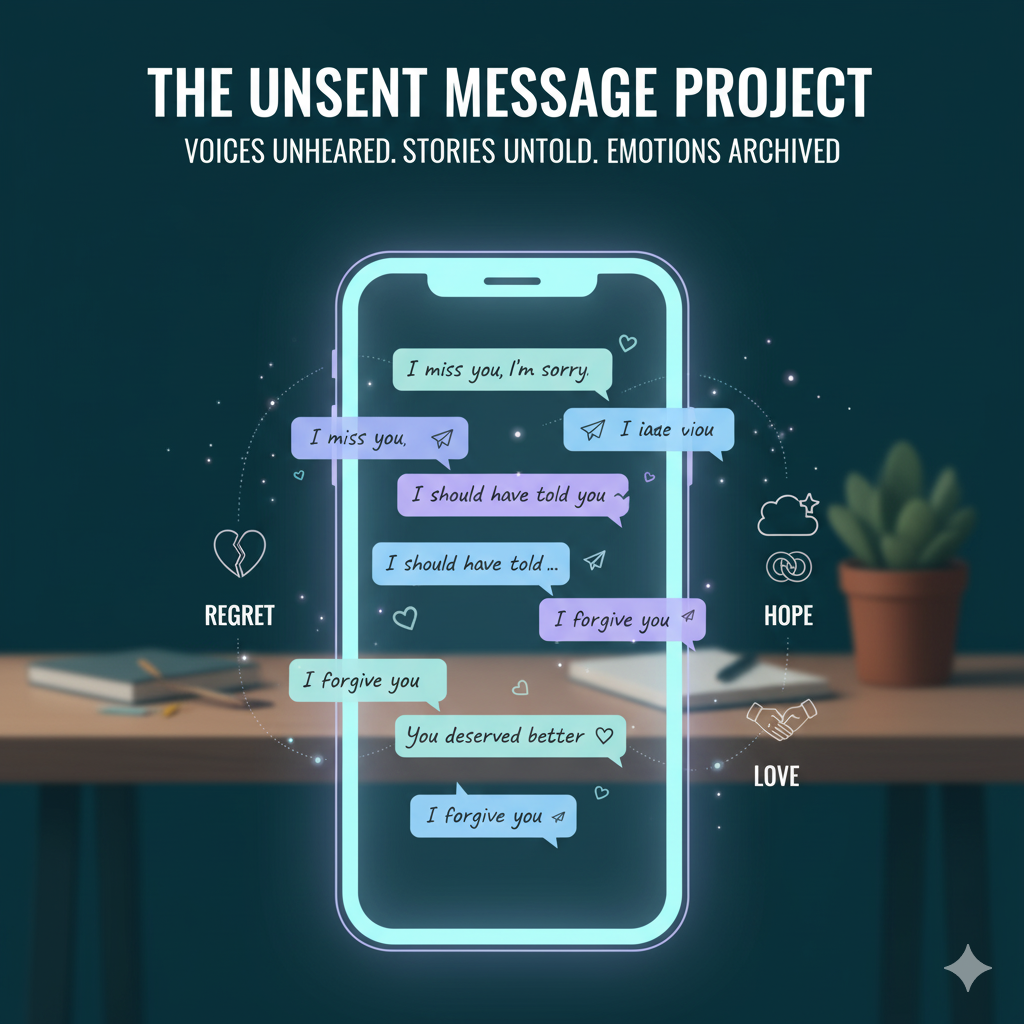
That’s the exact heartbeat of the Unsent Message Project. It’s a corner of the internet that catches those almost-words, wraps them in a color you choose, and sets them free in an anonymous gallery where strangers nod and say, “Yeah, me too.” In a world that screams “post it, send it, react now,” this project whispers back: the stuff you didn’t say might matter most.
Over the next stretch, we’ll wander through what it really is, where it came from, how it feels to use, why it hooks so many of us, the repeating themes you’ll spot, when to lean in (and when to step back), and what it’s teaching us about living online. Come along.
Defining the Unsent Message Project
At its core, the Unsent Message Project is a living scrapbook of almost-sent texts. You type the words you chickened out on—to an ex, a parent, your high-school best friend, even the you from ten years ago—pick a color that matches the ache or glow inside, and release it anonymously into a searchable archive.
It’s part art installation, part group therapy without the couch, part digital campfire where everyone’s telling the story they never told. Yeah, it grew out of the original Unsent Project that kicked off in 2015, but think bigger: this is the whole vibe of unsent communication finding a stage.
No login, no followers, no read receipts. Just your raw draft + a hue + the quiet click of “submit.” Suddenly your private hesitation becomes part of a chorus millions strong.
The Origin Story & Emotional Impetus
Picture an artist staring at her own unsent drafts, wondering: “If this feeling had a color, what would it be?” That curiosity birthed the whole thing. Start small—first loves only—then watch it snowball because everyone has an unsent something.
The spark isn’t tech; it’s pure human. We live in the fastest messaging era ever, yet we still pause, delete, second-guess. The Unsent Message Project says, “That pause is valid.” It scoops up the trailers we cut from our highlight reels and turns them into the main feature.
Fear of looking dumb. Terror of no reply. The “what if I ruin everything” spiral. The project doesn’t judge; it just hands you a blank page and says, “Put it here instead.”
The Mechanics: How the Unsent Message Project Operates
It’s simpler than your Notes app, and that’s the trick.
You land on the page—clean, quiet, no ads yelling at you. A box waits. You start typing: “To Jake, remember the night…” or “To the girl I was at 22…” Keep it short, keep it messy; perfection isn’t invited.
Next, the color wheel. This part always slows me down. Is the regret a bruised violet? The gratitude a soft butter yellow? You click what makes your shoulders drop.
Submit. No account, no “verify you’re human” nonsense. (Most platforms cap you at one a day so it stays real.) Your words slide into a moderation queue—because millions of submissions need guardrails—then pop up in the archive when ready.
Browsing is where it gets you. Punch in a name and hold your breath. Filter by color when you’re in a mood. Or just scroll and let the universe serve you someone else’s 2 a.m. truth. You’ll swear half the entries were copied from your own deleted drafts.
The loop closes when you realize: you didn’t need the reply. You needed the release.
Why the Unsent Message Project Resonates with So Many
We’re drowning in pings, yet starving for real talk. This project flips the script.
You get to be brutally honest without the fallout. No awkward “seen at 11:42 p.m.” No explaining yourself tomorrow. Just truth, set free.
Reading the archive is like walking into a room full of strangers and realizing every single one is carrying your exact brand of weird. That “me too” moment? Instant balm.
The color system turns feelings into something you can see. Text alone can lie; pair it with crimson or slate and suddenly the mood is undeniable.
In a culture obsessed with what we broadcast, celebrating what we withheld feels radical. The unsent message becomes the hero of its own quiet story.
And sometimes? You don’t need the conversation. You just need to say it out loud to the void. The project hands you the megaphone—then muffles the echo.
Themes & Emotional Currents in the Archive
Dive in for ten minutes and the patterns jump out like constellations.
First-love wreckage dominates—“I should’ve fought harder,” “You’ll never know I kept your hoodie.” But zoom out: “first” stretches to first real friendship, first adult betrayal, first time you chose yourself.
Apologies pile up like unread mail. “I’m sorry I let fear win.” Regret isn’t failure here; it’s proof you cared enough to ache.
Gratitude sneaks in softer: “You taught me parallel parking and parallel lives.” The thank-yous we never voiced because the moment felt too small.
Drift gets its own corner: “We just… stopped. And I never asked why.” The everyday fade-outs hurt in a slow-burn way the archive holds gently.
Then the greens—hope sprouting through cracks: “I’m learning to live without the sound of your name.” Healing looks quiet here, not triumphant.
Colors become shorthand. Blues flood because love and sadness share the same frequency. Reds scream passion or rage. Blacks are final periods. The archive turns into a living mood ring.
Calls & Cautions: Navigating the Unsent Message Project
Magic comes with edges. Let’s not pretend otherwise.
Anonymity is a double-edged sword. Freedom to spill, but you’ll never know if that poetic heartbreak was real or someone farming internet points.
Searching your own name? Tempting as hell. Zero hits can sting like rejection; a match can spiral into detective work. Set a timer, then close the tab.
The archive can ambush your feels. One minute you’re curious, next minute you’re sobbing over a stranger’s abortion story. If you’re already fragile, browse with a friend or a time limit.
Details are breadcrumbs. “That night at the lake with the broken radio”—someone might recognize the scene. Write like the person could still stumble across it.
Once it’s in, it’s in. Most platforms don’t do deletes. Treat submission like publishing a tiny memoir that might outlive your grandkids.
This isn’t therapy with follow-up. It’s a mirror. Reflections can be brutal. Have tissues—and backup support—nearby.
Integrating the Unsent Message Project into Your Life
Drawn to it? Here’s how to weave it in without losing yourself.
Write first, submit later. Sometimes the release happens the second the words hit the page. Keep a private “unsent” note on your phone; the archive is optional.
Pick your color like you mean it. Don’t just click blue because it’s pretty—ask what the feeling actually tastes like. That pause is half the medicine.
Browse with intention. Set a question before you dive: “What do I need to feel less alone tonight?” Let the archive answer.
Steal the ritual for real life. Journal club? Everyone writes an unsent note, picks a color from a shared paint deck, reads aloud if they want. Instant bonding.
Guard your heart. Ten messages max, then check in with yourself. Drained? Close the laptop, go touch grass. This is a tool, not a lifestyle.
The Unsent Message Project in the Cultural & Digital Conversation
We’re more connected than ever, yet somehow lonelier. This project lives in that paradox.
Our feeds are highlight reels; the archive is the blooper cut. Celebrating the unsent feels like digital rebellion.
Memory usually fades the stuff we didn’t say. Here, it’s preserved in amber. Future anthropologists will thank us.
In a world of filters and flexing, raw hesitation is the ultimate flex. The project says: “Here’s me, mid-pause, mid-mess.”
For builders: study the UX. Zero friction entry + emotional payoff + anonymity = addiction-level engagement. Color as metadata? Chef’s kiss.
Looking Ahead — What’s Next for the Unsent Message Project
The bones are solid; the future is wide open.
Imagine unsent voice memos—your shaky “I forgive you” at 3 a.m., color-tagged teal for tentative peace.
Pop-up galleries: archive messages projected on brick walls, strangers reading aloud under string lights.
Mood dashboards: “This week, 68% of submissions chose shades of gray—here’s what that might mean for collective mental weather.”
Guided reflection add-ons: submit your message, get a gentle prompt back—“What do you need to hear from your 10-years-ago self?”
Bigger archives = bigger responsibility. Robust moderation, clear removal policies, maybe age gates. The heart stays tender; the guardrails grow up.
FAQs About the Unsent Message Project
Final Reflection: The Quiet Strength of the Message You Never Sent
You’re here because some unsent text is still rattling around your ribcage. Maybe you open it every six months, add a period, delete it again. The Unsent Message Project doesn’t demand you hit send. It just says: “That bird in your chest? It’s real. Give it a perch.”
Write it, color it, release it—or don’t. Either way, you’re not crazy for carrying it. You’re human. And when you peek at the archive and see a thousand strangers carrying the same weight in the same shade you chose? That’s the moment the sky feels less empty.
Your unsent message isn’t silence. It’s proof you felt something worth pausing for. And now it has company.