You’ve felt it, haven’t you? Phone glowing in the dark, a half-written text staring back at you. “I still think about you every day.” Or “I’m sorry I disappeared.” Your thumb hovers, heart thumping, but something locks up. You delete the whole thing, word by word, until the screen’s blank again. That message doesn’t vanish, though—it curls up inside you like smoke you can’t quite exhale.
That’s the exact ache the Unsent Project Website was built for. It’s this quiet corner of the internet where those never-sent words finally land somewhere soft. You type them out, wrap them in a color that matches the feeling, and let them go—anonymous, safe, seen by strangers who somehow understand. In the lines ahead, we’ll wander through what the site really is, how it feels to use it, why it hooks people so deeply, ways to dip in (or borrow the idea for yourself), and a few gentle warnings. By the end, you’ll get why this isn’t just a submission form—it’s a mirror for every draft you ever abandoned.
What is the Unsent Project Website?
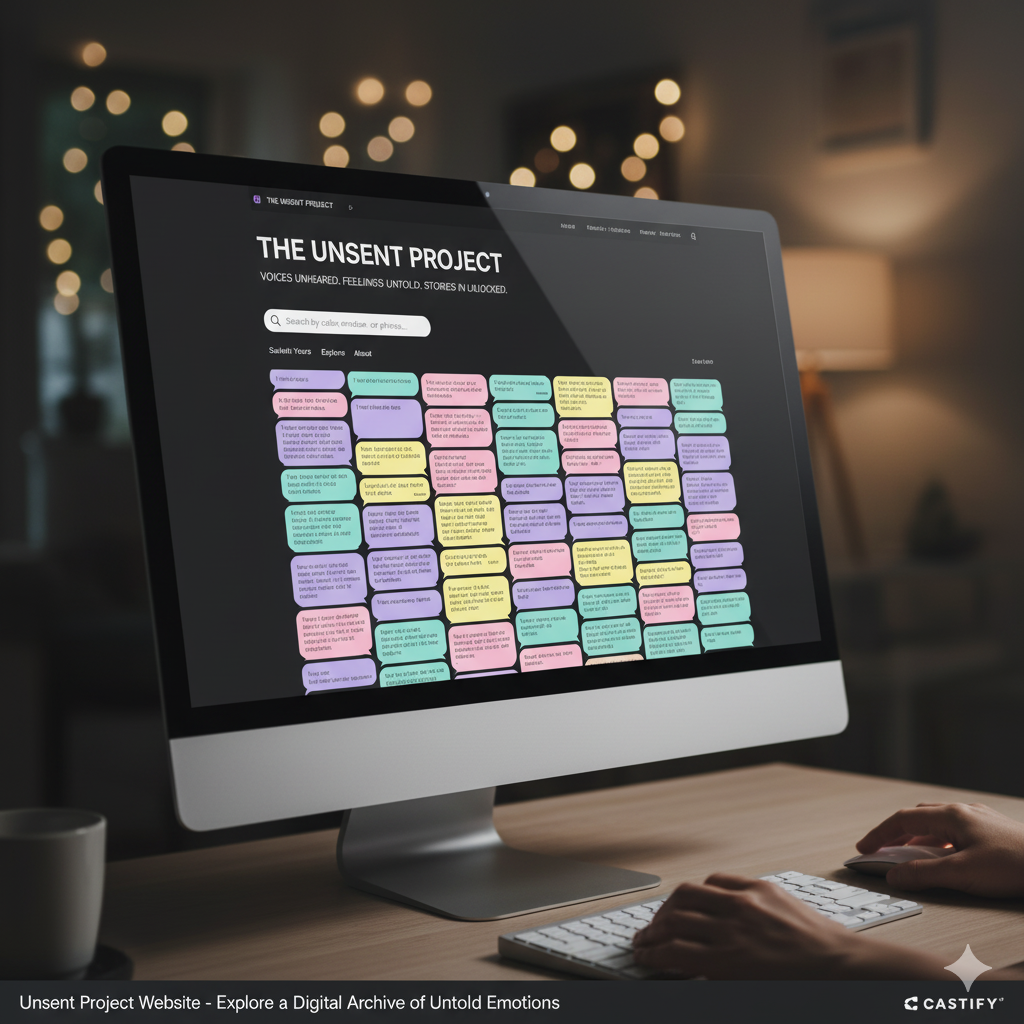
Strip away the tech talk, and the Unsent Project Website is a giant, ever-growing scrapbook of almost-words. Messages people typed, stared at, then chickened out on. You pour your unsent note into a box, pick a color that feels like the emotion behind it, hit submit, and poof—it joins millions of others in a searchable, anonymous archive.
Sure, it started with “first love” vibes, but it’s way bigger now. You’ll find confessions to old friends who drifted off, apologies to parents you never voiced, quiet “I miss you” notes to pets who crossed the rainbow bridge. It’s less a niche romance thing and more a universal vault for anything you swallowed instead of sending.
The Early Spark & Vision Behind the Site
Every cool corner of the internet has a human heartbeat behind it. Here, it’s an artist wondering out loud: “What color does your unsent feeling wear?” That simple question—text plus hue plus total anonymity—became the seed. The goal wasn’t fame or followers; it was giving those trapped words a place to breathe instead of rotting in your Notes app.
The vision feels almost tender: your silence doesn’t have to mean erasure. By turning private almost-confessions into a public (but faceless) gallery, the site whispers, “Hey, your unsent stuff still counts.” It’s emotional archaeology—digging up what we buried and laying it out under soft gallery lights.
How the Website Works: The User Experience
Let’s walk through it like you’re sitting next to me, laptop open, coffee steaming.
You land on the page—clean, calm, no screaming ads. There’s a box begging for your words. You might start with “To Sarah…” or “To the version of me from 2019…” or nothing at all. Whatever spills out first, you let it. No editing for eloquence; raw is the whole point.
Next, a color picker. This part always slows me down in the best way. Is this ache a bruised purple? Is the regret a smoldering charcoal? You click the shade that makes your chest unclench a little.
Submit. No account, no email, no “are you sure?” pop-ups—just one quiet click. (They usually cap it at one a day so it stays intentional.) Your words vanish into a moderation queue, then resurface in the archive whenever they’re ready.
Browsing is where the magic sneaks up. Search a name and hope (or dread) something appears. Filter by color when your mood matches—dive into the midnight blues or the angry reds. Or just scroll and let the universe serve you someone else’s unsent heart on a platter. You’ll swear half the entries were copied from your own drafts.
Themes & Emotional Landscape on the Website
Spend an hour wandering the archive and you start seeing the same ghosts in different clothes.
There’s the classic first-love ache—“I should’ve kissed you that night by the lake,” “You’ll never know how your laugh still echoes.” But then you stumble on quieter corners: “Dad, I forgive you for missing my graduation,” “To the friend who stopped texting back—hope you’re okay.” Some are just fragments: “Anyway…” trailing off into white space.
Apologies show up a lot, like people unloading backpacks they’ve carried for years. Gratitude too—“Thank you for teaching me how to parallel park, even though we broke up the next week.” And the soft goodbyes: “This is me letting you go without making it weird.”
Colors become shorthand. Blues flood the feed because love and sadness share the same shade half the time. Blacks feel like final periods. Pinks are the almosts—the flirtations that fizzled. Browsing by hue turns the whole site into a mood ring you can wear on your wrist.
What gets me every time? How familiar it all feels. You read a stranger’s three-line confession and think, “That’s the exact sentence I deleted at 2 a.m. last month.” The anonymity strips away the faces, but the feelings line up perfectly.
Why the Unsent Project Website Connects with People
We’re drowning in “post this, share that, react now.” This site flips the script—it celebrates the stuff we didn’t broadcast. In a feed full of curated highlights, honoring the deleted drafts feels rebellious and human.
You get to scream into the void without the void screaming back. No read receipts, no awkward “k,” no relationship earthquakes. Just release.
Scrolling proves you’re not the only one drafting novels you’ll never send. That shared vulnerability—even through total strangers—shrinks the loneliness a notch.
The design helps too. No profiles, no likes, no comment wars. Just words floating on color like Post-it notes on a gallery wall. It’s poetry without the pressure.
And there’s something archival about it. Your fleeting 3 a.m. thought becomes part of internet history. What we almost said, collectively, turns into a quiet cultural artifact.
How to Use the Website (and Variations)
Ready to try? Or maybe just borrow the vibe? Here’s your roadmap.
On the actual site: Open the page, spill the message that’s been looping in your head, pick the color that makes your gut say “yes,” submit. Then—and this is key—walk away. Come back later to browse. Search your own name on a brave day. Let the archive talk back to you.
Keep it private: Not feeling public? Make a folder called “Unsent.” Same ritual: write, pick a color (scribble it in the margin or highlight the text), save the file. No one ever sees it, but you still get the release. I do this on plane rides—therapeutic as hell.
Group or workshop style: Gather friends (or students, or grief-circle buddies). Everyone writes an unsent note, chooses a color on a shared wheel, reads aloud if they want. The “me too” moments hit like lightning. Borrow the site’s bones; make it yours.
Content creator twist: Writing a blog? Steal the structure—prompt readers to send you an unsent message + color. Curate the best (anonymously) into a post. Instant emotional engagement.
Ethical & Emotional Considerations
Beauty comes with edges. Let’s not pretend otherwise.
Anonymity isn’t ironclad. Drop enough specific details—“that night at the drive-in with the broken AC”—and someone might connect dots. Write like the person could still stumble across it.
The archive can ambush you. One minute you’re casually browsing pinks, next minute you’re ugly-crying over a stranger’s abortion regret. If you’re already raw, set a timer. This isn’t therapy with tissues.
Sometimes writing it out doesn’t close the loop. It might crack the wound wider. If that happens, reach for a friend, a journal, a professional—don’t let the site be your only outlet.
Once it’s in, it’s in. Most messages can’t be deleted. Treat submission like publishing a tiny zine that might outlive you.
And when you read? Remember these are real heartbeats. Don’t play detective. Let the words stay sacred.
The Design & Technical Side of the Website
Okay, fellow builder—let’s geek out for a second.
The submission flow is stupidly smooth: no login, no CAPTCHA hell, just three fields and a button. That frictionless entry is why people actually use it.
Color as metadata is genius. Instead of clunky tags (“sad-romance-apology”), one click on “blue” surfaces every melancholy entry. Elegant, emotional, scalable.
Anonymity is baked in—no cookies tying you to submissions, no IP logging visible to users. Behind the scenes, there’s clearly a moderation queue (probably a mix of automated filters and human eyes) to keep out the trolls.
The UI is minimalist poetry: full-bleed color block, centered text, zero navigation clutter. Mobile responsive without trying hard. You could rebuild the core in a weekend with React, a simple backend, and a color picker library.
Scaling millions of entries means smart indexing—full-text search on messages, secondary indices on names and hex codes. Bonus points if they’re doing sentiment analysis under the hood to surface trending moods.
Standing Out: What This Website Offers That Others Miss
Most articles give you the Wikipedia version: “Started in 2015, submit text + color, blah blah.” We’re doing more.
We’re inviting you in—not just explaining, but walking beside you as you type your first unsent line.
We’re mapping the emotional journey, not just the feature list: draft → color → release → reflection.
We’re speaking developer too—UX breakdowns, tech implications—without alienating the feels crowd.
We’re handing you off-ramps: private versions, workshop prompts, content ideas.
We’re weaving LSI naturally—“archive of deleted drafts,” “digital vault for almost-confessions”—so search engines and hearts find us.
Why the Unsent Project Website Is Relevant for SEO & Content Writing
Want this topic to rank? Live the keyword like it’s your native language. “Unsent Project Website” in the title, H2s, first paragraph, image alts—without sounding robotic.
Layer related phrases conversationally: “platform for messages you chickened out on,” “anonymous gallery of almost-texts.”
Go deep. Surface-level “how to submit” posts are dime-a-dozen. We’re giving emotional arcs, tech breakdowns, ethical nuance—Google eats depth for breakfast.
Link internally if you’ve got related posts (digital minimalism, expressive writing, color psychology). Encourage shares with lines like “Tag the friend who needs to see this archive.”
Break the mold on structure. Everyone else does bullet-point FAQs; we’re storytelling with gentle prompts. Stand out, rank higher, connect deeper.
Potential Future of the Website & Similar Platforms
Where could this vibe evolve?
Imagine voice memos you never sent—record at 1 a.m., pick a color, let it join the chorus. Or photos: the unsent selfie with a caption you deleted.
A mobile app with midnight push prompts: “Something keeping you up? Unsend it.”
Safe, opt-in reply threads—“Someone resonated with your blue message”—still anonymous, but conversational.
Physical pop-ups: archive prints in galleries, zines sold for charity, live readings where strangers voice each other’s unsent words.
Aggregate insights: “This month, 62% of submissions chose shades of gray—here’s what that might mean.” (With zero personal data, of course.)
Bigger archives mean bigger responsibility—robust moderation, clear removal policies, maybe age gates. The heart stays the same; the guardrails grow up.
FAQs About the Unsent Project Website
Final Take: Why the Unsent Project Website Matters
Here’s the quiet truth: the messages we don’t send often weigh more than the ones we do. They loop in our heads, color our silences, shape the roads we take. The Unsent Project Website doesn’t force you to hit send—it gives your almost-words a soft landing instead.
Whether you submit to the archive or just borrow the ritual for your bedside journal, the act says: “This feeling existed. It mattered. I’m not crazy for carrying it.” And when you read someone else’s matching ache in the same shade of blue you chose? That’s the moment the loneliness cracks open, just enough for light to sneak in.